Tea Master
Gongfu tea brewing
Gongfu cha is a Chinese way of brewing with a lot of leaf in a small vessel and many short steeps. Use a 100–150 ml gaiwan or teapot, 5–8 g of leaf per 100 ml, rinse once, then start at 5–10 seconds and add 5–10 seconds each round. Good oolong and pu-erh give 7–15 steeps, each tasting a little different.
What gongfu cha means
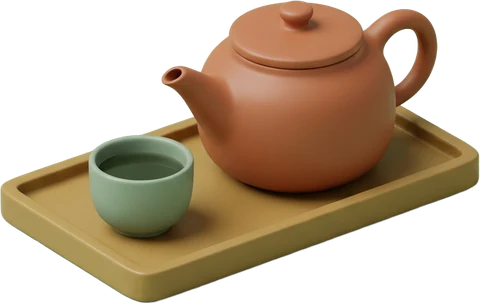
Gongfu (also written gong fu or kung fu) means skill that comes from practice. Gongfu cha is brewing tea with that kind of care: you control the leaf, the water and the seconds closely. The style comes from southern China, especially Chaozhou and Fujian, where it grew up around oolong.
The idea is simple. Western brewing puts 1–2 g of leaf in a large pot for 3–4 minutes and gives one or two pots. Gongfu puts three to five times more leaf in a much smaller vessel and pours it off after seconds. You drink many small cups of 30–50 ml and follow the tea as it changes, from aroma-heavy early steeps to sweet, mellow late ones.
You do not need a ceremony. A gaiwan, a kettle and a cup are enough to start.
Gongfu parameters at a glance
| Setting | Typical value |
|---|---|
| Vessel | 100–150 ml (3.4–5 fl oz) gaiwan or teapot |
| Leaf | 5–8 g per 100 ml for oolong and pu-erh, 3 g for white and most black teas |
| Rinse | 5–10 s, poured away |
| First steep | 5–10 s (20–30 s for delicate teas) |
| Each next steep | +5–10 s at first, longer near the end |
| Number of steeps | 7–15 for good oolong and pu-erh |
Gongfu teaware: what you need
- Gaiwan or small teapot. A porcelain gaiwan of 100–150 ml is the most useful first piece: neutral in taste, easy to clean, and you can see and smell the leaf. Unglazed clay pots (Yixing, Chaozhou) are lovely later, ideally one per type of tea. Learn the grip in how to use a gaiwan.
- Fairness pitcher (gong dao bei). You decant the whole steep into it so every cup gets the same strength.
- Small cups. 30–50 ml each. They cool fast enough to sip right away.
- Strainer. Catches broken leaf between the gaiwan and the pitcher.
- Kettle with temperature control. Very useful, since teas range from 80 °C (176 °F) to boiling.
- Tea tray or a bowl. Catches rinse water and spills. A deep plate works.
- Scale. A pocket scale with 0.1 g steps makes your results repeatable.
How to brew gongfu style, step by step
- Weigh the leaf. Vessel size times the ratio: for a 120 ml gaiwan and 7 g per 100 ml, that is 8.4 g.
- Heat the water to the tea's temperature. Rolled oolong and pu-erh take 95 °C (203 °F), roasted rock oolong takes boiling water.
- Warm the teaware. Pour hot water into the gaiwan, pitcher and cups, then empty them.
- Add the leaf and smell it in the warm, dry vessel. This is one of the best aromas of the session.
- Rinse. Cover the leaf with water and pour it off after 5–10 seconds. Skip the rinse for delicate green and white teas.
- First steep. Fill to just below the rim, lid on, pour off completely after 5–10 seconds into the pitcher.
- Serve from the pitcher into the cups. Lift the gaiwan lid and smell it between steeps.
- Repeat with more time. Add 5–10 seconds per steep at first. When the tea weakens, add 20–60 seconds or more.
- Stop when a long steep tastes thin. The spent leaf can go one last time as a long western-style steep.
Keeping count of steeps is the hard part when you talk with friends. The Tea Master gongfu timer counts every steep and moves to the next time, with pause, skip and repeat.
Gongfu schedules for popular teas
| Tea | Water | g per 100 ml | Steeps (s) |
|---|---|---|---|
| Shu pu-erh | 95 °C (203 °F) | 7 | 10, 15, 20, 30, 45, 60, 80 |
| Sheng pu-erh | 95 °C (203 °F) | 8 | 10, 15, 15, 25, 40, 60 |
| Tie Guan Yin, Da Hong Pao | 95 °C (203 °F) | 7 | 10, 15, 20, 30, 45, 60, 80 |
| Rou Gui | 100 °C (212 °F) | 7 | 5, 5, 10, 15, 30, 50, 80, 110, 150, 200, 250 |
| Dan Cong | 92 °C (198 °F) | 5 | 5, 10, 15, 20, 30, 40, 55, 75, 100 |
| Silver Needle | 82 °C (180 °F) | 3 | 20, 25, 30, 40, 50, 70, 90 |
| Dian Hong Golden Buds | 85 °C (185 °F) | 3 | 20, 25, 25, 40, 45, 50, 60, 70 |
| Green tea | 82 °C (180 °F) | 5 | 30, 45, 60, 90, 120, 180 |
More detail by tea: how to brew oolong and how to brew pu-erh.
Common gongfu mistakes
- Western amounts of leaf in a gaiwan. With 2 g in 120 ml the short steeps taste like water.
- Not draining fully. The leftover water over-brews the leaf and the next steep turns bitter. Shake out the last drops.
- Counting in your head. Ten seconds feels long while you pour. Use a timer, at least while you learn a tea. Our tea timer guide explains what to look for.
- Overfilling the gaiwan. Water up to the rim burns fingers and spills. Stop a few millimetres below.
- Boiling water for every tea. Delicate green and white teas want 80–85 °C (176–185 °F).
- Giving up after three steeps. Rolled oolong and pu-erh often peak in the middle of the session.