Tea Master
How to use a gaiwan
Hold the gaiwan by its flared rim with your thumb and middle finger, keep your index finger on the lid knob, tilt the lid to leave a small gap, and pour everything out in one quick motion. Choose a 100–150 ml (3.4–5 fl oz) gaiwan and fill it only to just below the rim, so the top edge stays cool enough to touch.
What a gaiwan is
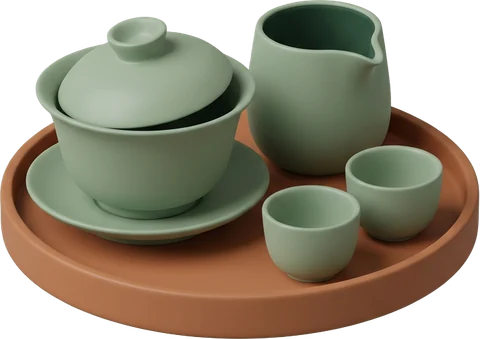
Gaiwan means lidded bowl in Chinese. It has three parts: a small bowl, a lid that sits inside the rim, and a saucer. It was a drinking cup first, and you can still sip straight from it, holding the lid back to keep the leaves in. Today it is mostly used as a brewing vessel for gongfu tea: you steep the leaf for seconds and pour the tea out into a pitcher or cups.
The gaiwan is popular because it is neutral and simple. Porcelain does not absorb flavour, so one gaiwan works for every tea. The wide opening lets you add and remove leaves easily, watch them open, and smell the lid between steeps.
Gaiwan sizes and how much leaf
| Gaiwan size | Good for | Rolled oolong or shu pu-erh (7 g per 100 ml) | White or black tea (3 g per 100 ml) |
|---|---|---|---|
| 80–100 ml (2.7–3.4 fl oz) | One person, strong teas | 5.5–7 g | 2.5–3 g |
| 120 ml (4 fl oz) | One or two people | 8.4 g | 3.6 g |
| 150 ml (5 fl oz) | Two or three people | 10.5 g | 4.5 g |
| 200 ml and up | Groups, green tea | 14 g and up | 6 g and up |
For a first gaiwan, 100–150 ml is easiest to handle. Larger ones get heavy and hot, and pouring them fast enough is hard. The volume printed on a gaiwan is usually filled to the brim; the usable volume is about 10–20 ml less.
How to hold and pour a gaiwan, step by step
- Warm it. Pour hot water in, swirl, pour out. A warm gaiwan holds the temperature.
- Add the leaf and put the lid on for a few seconds. Lift it and smell the dry leaf.
- Pour the water in a circle over the leaf, up to just below the rim. Leave a few millimetres of dry porcelain at the top. That cool band is where your fingers go.
- Put the lid on and tilt it slightly towards you, so a narrow gap opens on the far side. The gap should be thinner than the leaves.
- Grip. Thumb and middle finger on opposite sides of the rim, on the flared lip. Index finger presses the lid knob. Your fingers touch only the rim and the knob, never the hot walls.
- Pour fast. Lift, tip it towards the pitcher until it is almost upside down, and let it drain in two or three seconds. A slow pour keeps brewing the tea.
- Drain fully. Give a small shake for the last drops. Water left on the leaf over-brews the next steep.
- Set it down on the saucer with the lid slightly open if you want the leaf to stop steaming between steeps, or closed to keep it hot.
Many people find it easier to lift the gaiwan without its saucer. Use whichever feels steadier.
How not to burn your fingers
- Fill less. Water up to the rim is the main reason people get burned. Leave a dry edge.
- Choose a flared lip. A rim that turns outwards keeps your fingers away from the water.
- Pick thicker porcelain or a gaiwan with a double wall. Thin glass and thin porcelain get very hot.
- Keep the rim dry. Wet porcelain carries heat into your skin faster. Wipe it if water splashes.
- Practise with cool water a few times. Once the grip feels natural, switch to hot.
- Use a smaller gaiwan for boiling-water teas such as rock oolong and aged pu-erh.
Porcelain, clay or glass, and gaiwan vs teapot
Porcelain is the best all-rounder. It does not hold flavours, so you can brew green tea after pu-erh. Glass shows the leaves but loses heat fast and gets hot to touch. Clay gaiwans hold heat well and soften the taste; like clay teapots, they slowly absorb flavour, so many people keep one for a single kind of tea.
Gaiwan vs teapot: a gaiwan is easier to clean, lets you see and smell the leaves, and works for every tea. A small clay teapot keeps heat better, pours more neatly, and is safer for your fingers, but it is harder to clean and best kept for one tea type. Most people start with a gaiwan and add a teapot later for oolong or pu-erh.
Which teas suit a gaiwan
- Oolong: the classic match. Tie Guan Yin and Da Hong Pao at 95 °C (203 °F), 7 g per 100 ml. See how to brew oolong.
- Pu-erh: 7 g of shu per 100 ml at 95 °C (203 °F), rinse first. See how to brew pu-erh.
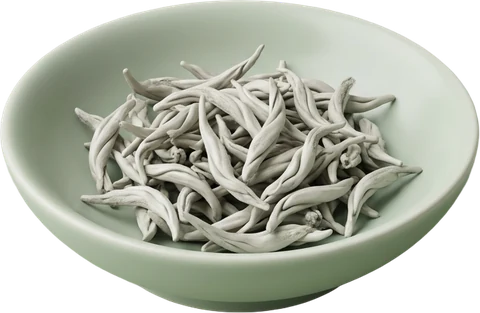
- White tea: Silver Needle at 82 °C (180 °F), 3 g per 100 ml, lid off between steeps.
- Green tea: leave the lid off or ajar so the leaves do not stew. Lower water, 80–82 °C (176–180 °F).
- Chinese black tea: 3 g per 100 ml at 85–90 °C (185–194 °F) for most.
Common gaiwan mistakes
- Gaiwan too large for your hand. You cannot pour it fast, and the tea over-brews.
- Lid gap too wide. Leaves slip out. Tilt the lid just enough for water.
- Gripping the bowl. Only the rim and the knob are safe to touch.
- Washing with soap and leaving it wet. Rinse porcelain with hot water and let it dry open; a soft brush handles tea stains.